
Resumen
Intervenir en entornos hostiles no es el único desafío que enfrenta el Trabajo Social, según profesionales deben enfrentar las limitaciones del sistema de protección social y trabajar con recursos condicionados a tener un informe, no al frente a las necesidades vastas que debería ofrecer los programas de apoyo social.
Introduction
Social work is defined as a discipline and profession grounded in human rights and human dignity, centering on the pursuit of social justice and the improvement of living conditions; the profession strives to alleviate poverty and promote inclusion and social cohesion.
Social work practice is evolving toward more critical, structural approaches in response to political, economic, and cultural changes.
This article seeks to understand how social workers adapt to new social demands and challenges—such as inequality, a lack of training and resources, and structural barriers—in rural, regional, and local areas. Drawing on expert opinions, it aims to raise awareness regarding the diverse, specific concerns of the profession. Adapting social work is essential for addressing emerging issues and preparing professionals for new demands; this highlights the importance of continued innovation in social work training and practice—starting at the academic level. Consequently, a thorough reflection is required regarding the social worker's role in addressing these social issues, particularly in light of the challenges and difficulties that limit their capacity for intervention on an international scale.
Social work is viewed as a discipline focused on social development and cohesion, upholding ethical values when confronting social conflicts. This field involves not only a humanitarian dimension but also an emphasis on practical challenges, aiming to enhance well-being and facilitate social change grounded in a conscious, progressive commitment to justice.
Broadly speaking, a key challenge for social work today is responding to increasingly complex realities—particularly in areas with high rates of poverty and violence—while seeking to transform lives. To address this issue, a methodology involving professional interviews and a review of academic literature was employed. The results indicate that a lack of recognition, excessive workloads, and insufficient resources severely limit the quality of interventions. As a potential solution, it is proposed that strengthening institutional support, improving working conditions, and highlighting the value of the profession will enable practitioners to better meet these challenges and ensure more comprehensive support for communities.
Development
Social Work is a profession that promotes structural and lasting change; to achieve this, it is essential to understand the specific dynamics of each territory and adapt models and strategies to the needs of each population. The true potential of the social worker lies in the ability to question and transform conditions that generate inequality; otherwise, there is a risk of perpetuating community dependency without addressing root causes (UNIR, 2025).
Social workers have an obligation to integrate theory into practice; the challenge is to reflect and be proactive, which entails making significant use of approaches, techniques, and research methods from other fields. It is one of the few professions that prioritizes the perspectives, feelings, and opinions of the stakeholders with whom it engages (Montealegre Pinto, 2025).
Social workers collaborate with psychologists, physicians, nurses, and others to develop a holistic approach and provide more comprehensive care (Current Issues in Social Work FSU, 2023).
Furthermore, according to Mendoza (2025), "Social Work is an essential tool for implementing inclusive and sustainable policies that promote social well-being" (p. 1533). The significance of this study lies in understanding how social workers can enhance their impact on social transformation by characterizing diverse beliefs, religions, ethnicities, and needs—grounded in inclusion and social support.
However, we must acknowledge that, with rising life expectancy, traditional family care structures are collapsing. According to the International Federation of Social Workers (IFSW), the profession is engaged in intense debate regarding how to ensure dignified care for the elderly and dependent individuals, as well as how to formalize or foster harmony within families by eradicating violence and recognizing socioeconomic, personal, and cultural factors.
Along these lines, it is essential to understand that social work is linked to universal rights, recognizing that all individuals are equal—without distinction or conditions that compromise personal integrity or morality—in order to uphold the Universal Declaration of Human Rights and protect universal rights against all forms of discrimination. This is particularly relevant given the current tendency of States to reduce these rights to mere palliative or welfare-based measures, whereas, in reality, they represent the fundamental principles that drive the world toward human coexistence and social harmony (Araneda Rivera, 2025).
Similarly, another challenge for social work is that professionals must operate in highly complex contexts—particularly in areas characterized by high poverty rates, a lack of basic services, violence, and discrimination. In such scenarios, interventions must be rapid and effective, leveraging social networks to streamline communication and ensure continuous follow-up for the individuals being served. Furthermore, social workers— particularly those focused on teaching and professional training—confront complex issues such as rising social conflicts, including unemployment, forced migration, and various forms of violence, especially domestic violence. It is crucial to highlight current regional unemployment figures from INEC surveys, which indicate that approximately 86,000 people lost their jobs, causing the unemployment rate to rise from 3.9% to 52.6% (Primicias, 2026). Additionally, the 2026 global report notes that violence—stemming not only from domestic issues but also from economic, social, and cultural factors, as well as organized crime—has disproportionately affected children. As the most vulnerable group, they are a key focus for social work; beyond addressing economic needs, the protection of minors remains a critical priority (Human Rights Watch, 2026).
Consequently, regardless of fluctuations in social conflict, a lack of social support coverage persists in rural areas, where poverty and extreme poverty rates stand at 42% and 25%, respectively. These evolving needs are highly relevant to the comprehensive training of social work professionals, who will ultimately face the significant challenge of mitigating these issues through the social support that society requires once they begin practicing the profession.
Equally important, the education and training of social workers must be comprehensive and continuous, taking into account the essential knowledge required for effective future application. This entails analyzing the teaching-learning process in professional training and incorporating practices such as community mediation, group resilience, and primary psychological support tools directly into fieldwork interventions. University education plays a vital role in this training process; the academic approach begins in the classroom, where theory provides the foundation but practice is fundamental, utilizing strategies linked to social realities and emerging conflict trends. Consequently, ethics, professional conduct standards, and moral values remain crucial in professional preparation—principles effectively applied at global, regional, and local levels.
In short, best practices, assertive communication, and a fundamental understanding of mediation rules—recognized by the Constitution of the Republic of Ecuador as an alternative conflict resolution method—are integral to fostering social justice, and social workers must be prepared for this role. This highlights the importance of professional intervention and assistance in conflict situations, as well as the need to address various dimensions through a rights-based approach (Mendoza Andrade, 2025).
Social work professionals worldwide are essential to ensuring just and sustainable social development. Moving toward effective practice requires addressing the structural inequalities that limit access to services and equitable resource distribution. High self- expectations and ethical commitment often go unrecognized, leading to burnout; in their drive to meet expectations, social workers may end up self-exploiting, suffering from anxiety and chronic exhaustion. Instead of guaranteeing well-being, the State shifts the burden onto the individuals working on the front lines. Nevertheless, the profession must align with the UN’s 2030 Agenda, coordinating social and economic policies to advance the concept of *Buen Vivir* (Good Living) in the region (Castro Távara, 2026).
Applied methodology and techniques
To achieve this objective, qualitative strategies were implemented—based on a literature review, document analysis, and interviews with practicing social workers. The methodology employed is qualitative with an inductive approach, as it is considered that establishing a common practical foundation for the research process requires taking into account both theory and descriptive analysis regarding the issue at hand (Hecker, 2026).
Accordingly, this article employs research techniques to analyze the significance of current challenges in social work, utilizing semi-structured interviews with professionals in the field.
Results
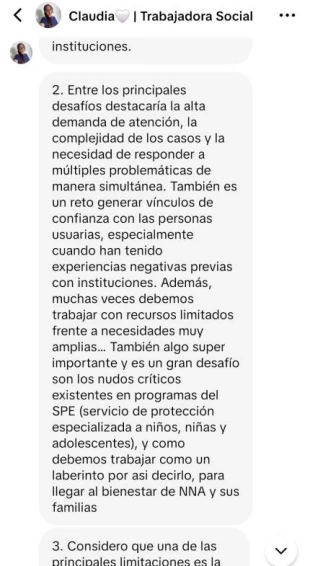
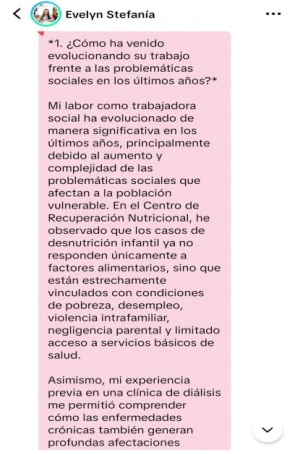
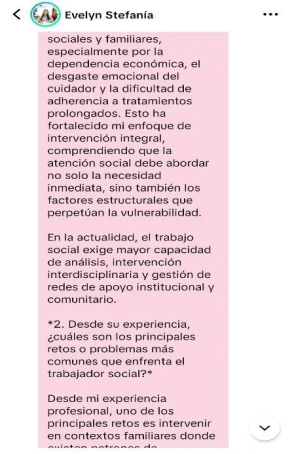
The techniques employed in the article made it possible to validate the descriptive analysis presented, adopting a critical perspective on the key challenges facing social workers—challenges that complement the theories discussed in the body of the text. The questions were addressed to two social work professionals: Evelyn, an Ecuadorian national, and Claudia, from Chile.
| PREGUNTAS | ENTREVISTADO 1 | ENTREVISTADO 2 |
|---|---|---|
| How has your work addressing social issues evolved in recent years? | It has evolved significantly due to the increase in and complexity of social issues; today, social work demands greater analytical capacity, interdisciplinary intervention, and the management of institutional and community support networks. | Social issues are becoming increasingly complex; situations related to mental health—such as domestic violence, the violation of the rights of children and adolescents, and economic hardship—are currently arising with greater frequency. |
| Based on your experience, what are the main challenges or most common problems facing social work today? | Social workers face the challenge of mediating between the urgent needs of the population and the limitations of the social protection system; another significant challenge is the resistance of certain families to institutional support processes. | Building bonds of trust with people is a challenge, particularly when they have had previous negative experiences with institutions; another challenge lies in the critical bottlenecks within Specialized Child and Adolescent Protection Services (SPE) programs, requiring us to navigate a labyrinthine system to achieve the well-being of children, adolescents, and their families. |
| What limitations do you encounter regarding working conditions, resources, professional recognition, or institutional support that prevent you from performing your work in the best possible way? | Issues include excessive workloads, insufficient human resources to handle a high volume of complex cases, and a lack of financial resources for social support programs; furthermore, institutional support is not always adequate, and—regrettably—a reductionist view regarding the recognition of social work still persists. | There are limitations such as excessive workloads and a scarcity of human and material resources; there are also constraints linked to administrative bureaucracy, which can detract from time spent on direct intervention with individuals and communities. It is necessary to strengthen the recognition of social work and to promote greater participation in institutional decision- making. |
| What consequences do these difficulties have for professionals, the population served, and the image of the profession? | This can lead to workplace stress, compassion fatigue, and even burnout; for the population, it can result in delayed interventions, a lack of continuity in the process, and reduced access to effective solutions; regarding the profession's image, it weakens the perception of its impact and can lead to an underestimation of the strategic contribution of social work. | For professionals, these difficulties can lead to stress, emotional strain, and a risk of burnout. For the population served, they can translate into longer wait times, less continuity in support processes, and difficulties in accessing certain forms of assistance in a timely manner. Regarding the profession, these limitations can affect the perception of the work's effectiveness, even though outcomes often depend on structural factors that lie beyond the individual efforts of social workers. |
| Do you think mediation is related to social work? | Yes, both disciplines are interrelated, as they act as facilitators in rebuilding the social fabric and share the goals of promoting social well-being and strengthening interpersonal and collective relationships. | They are related in that both seek the peaceful resolution of conflicts; within social work, mediation is used as a professional intervention tool that fosters dialogue and promotes agreements respecting the rights of both parties. |
| What is the impact of social work at the local, global, and regional levels? | Social work, both here in Ecuador and across Latin America, has played a crucial role due to persistent socioeconomic inequalities, limited access to basic services, and local and regional migration. Globally, the field has gained significance in the design and implementation of public policies aimed at protecting human rights; international bodies such as the International Federation of Social Workers and the United Nations recognize its contribution to fostering more equitable and inclusive societies. | Social work has a significant impact at global, regional, and local levels, as it directly addresses social inequalities, exclusion, and the violation of individuals' rights; for instance, social workers promote the observance of human rights and intervene in situations involving humanitarian crises, migration, poverty, and violence. The profession also strengthens social policies globally—a key factor for international organizations such as the UN and UNICEF. Locally, here in Chile, interventions take place in contexts of high social inequality, involving work with child and adolescent protection systems such as the Local Childhood Offices (OLN). |
Prepared by: Mgtr Roxanna Rivadeneira and Karen Villao (ULVR)
Discusión
The interviews reveal that the challenges facing social work share many similarities
across different contexts and countries—such as heavy workloads, resource
shortages, and, regrettably, a lack of recognition in certain places. Social workers face
significant constraints, despite belonging to a profession dedicated to upholding
human rights. Consequently, a personalized and in-depth approach is required to
overcome systemic obstacles; this highlights that if social work fails to fully achieve its
objectives, it is not due to a failure of the profession itself, but rather to conditions—
such as social conflict—that hinder its efforts or limit social support.
Conclusions
Social work encompasses a wide range of activities and plays a crucial role in building trust and a sense of security; this reinforces a comprehensive intervention approach, as social care must address both immediate needs and the structural factors that perpetuate vulnerability. While the field involves technical expertise, case management, and the protection of rights, it is—regrettably—undervalued; as professionals often note, it receives little to no recognition. This leads to excessive workloads, stress, and burnout, affecting not only the practitioners themselves but also the individuals they serve.
Strengthening recognition of the profession is essential, particularly as cases of violence, malnutrition, economic hardship, and other issues become increasingly frequent; it is vital that social work continues to fulfill its objectives.
Bibliographic References
Asamblea Constituyente. (2008). Constitución de la República del Ecuador. Asamblea Constituyente.
Araneda Rivera, F. (2025). Entre el rendimiento y la resistencia. Desafíos del Trabajo Social en la sociedad del cansancio. Obtenido de Le Monde Diplomatique: https://www.lemondediplomatique.cl/entre-el-rendimiento-y-la-resistencia-desafios-del-trabajo-social-en-la.html
Castro Távara, M. (2026). Trabajo Social: Formación profesional y Desafíos para el ejercicio profesional al 2030. Obtenido de Centro Latinoamericano de Trabajo Social: https://celats.org/noticias/trabajo-social-formacion-profesional-y-desafios-para-el-ejercicio-profesional-al-2030/#:~:text=El%20Trabajo%20Social%20en%20la,al%20profesional%20de%20Trabajo%20Social
Current Issues in Social Work FSU. (2023). Current Issues in Social Work FSU. Obtenido de College of Social Work: https://onlinemsw.fsu.edu/blog/current-issues-in-social-work
Hecker, J. (2026). Métodos de investigación cualitativa. Retrieved from Atlas.ti: https://atlasti.com/es/guias/guia-investigacion-cualitativa-parte-1/metodos-de-investigacion-cualitativa
Human Rights Watch. (2026). Human Rights Watch. Obtenido de Informe Mundial 2026 Ecuador: https://www.hrw.org/es/world-report/2026/country-chapters/ecuador
International Federation of Social Workers. (s/f). International Federation of Social Workers. Obtenido de Definición Global del Trabajo Social: https://www.ifsw.org/what-is-social-work/global-definition-of-social-work/definicion-global-del-trabajo-social/?need_sec_link=1&sec_link_scene=im
Mendoza Andrade, M. (2025). El Trabajo Social en el Ecuador en el siglo XXI: Una Perspectiva Integral. Veritas Revista Multidisciplinar , p. 3. doi:https://doi.org/10.61616/rvdc.v6i1.471
Montealegre Pinto, A. (2025). Desafíos del Trabajo Social: hacia un campo de investigación con identidad propia. Obtenido de Universidad Santiago de Cali (USC): https://unimedios.usc.edu.co/desafios-del-trabajo-social-hacia-un-campo-de-investigacion-con-identidad-propia/#:~:text=Los%20Trabajadores%20Sociales%20enfrentan%20el,se%20encuentra%20en%20constante%20evoluci%C3%B3n
Naciones Unidas. (1948). Naciones Unidas. Obtenido de La Declaración Universal de los Derechos Humanos: https://www.un.org/es/about-us/universal-declaration-of-human-rights
Primicias. (2026). El desempleo cayó en Ecuador, en mayo de 2026 . Obtenido de Primicias: https://www.primicias.ec/economia/desempleo-ecuador-mayo2026-empleo-adecuado-subempleo-informal-trabajadores-inec-126077/
UNIR. (2025). Desafíos en la intervención social comunitaria en los entornos urbanos y rurales de Latinoamérica. Obtenido de UNIR. La universidad en Internet: https://ecuador.unir.net/actualidad-unir/desafios-intervencion-social-comunitaria-entornos-urbanos-y-rurales-latinoamerica/
Appendices
Interview evidence – Social Work professionals, via TikTok (social media)..