


Social workers who intervene in gender-based violence are the key figures in the fight against this social scourge. The labor climate in which they carry out their functions can affect their own health and also the quality of care received by women, who must be protected by the public administration. Despite its importance, occupational health is a problem that Social Work currently faces, as it is not common for institutions to worry about the consequences of continuous work with violence on the professionals who accompany survivor women. On the contrary, cases of victims of sexist violence are repeated every year in Spain while economic and personnel resources do not increase at the necessary pace. The existing imbalance between the demand for help and the supply of resources can have direct consequences on the health of those who provide direct care, who are mostly female professionals given that work in sexist violence is a highly feminized field.
Therefore, our objective is to understand the conditions in which professionals who assist women who have suffered gender violence work in the Women's Center Network (RCM) of the Valencian Community (Spain) and to know if this labor ecosystem and the consequences it produces are adequate for the professionals and for the women served. To this end, a mixed methodology was used, combining qualitative and quantitative techniques through the administration of an ad hoc questionnaire to 39 professionals who intervene in these specialized resources.
As results, the professionals point out that they have been suffering from a series of difficulties, deficiencies, and job precariousness for years that make their work very difficult and pose psychosocial risks. According to the National Institute for Safety and Health at Work (2025), there are a series of psychosocial risks at work that can affect the physical, psychological, or social health of workers due to poor organization and management of tasks and a negative work environment. These risks can manifest as work stress, violence and harassment by colleagues and/or superiors, lack of support causing isolation, job insecurity due to uncertainty in job continuity, and a lack of work-life balance. These factors can cause anxiety, depression, cardiovascular problems, and other physical and mental factors, especially if companies do not implement preventive measures to improve the work environment.
In the case of professionals working in sexist violence, specific factors can lead to professional exhaustion, compassion fatigue, and burnout syndrome:
a) Working with situations of suffering and violence makes emotional disconnection difficult at the end of the day.
b) The effort to empathize can lead to "empathy wear" due to the emotional load, permanent exposure to the pain of others, lack of time, and pressure to meet objectives.
c) Necessary urgent decisions—such as hospital visits, filing reports, or center admissions—often involve risks to the physical integrity of both the woman and the professional.
d) Work is hindered by a lack of resources, slow justice, lack of social housing, saturated resources, and overwhelmed professionals.
e) Professionals may feel responsible for what happens to the woman, yet supportive supervision and service evaluation are often absent.
f) Work schedules in shifts (mornings, afternoons, nights, weekends) hinder rest and work-life balance for the predominantly female workforce.
g) Labor conditions regarding wages, shift systems, and night work are generally poor, with excessive hours and precarious labor agreements being common.
h) Professionals must constantly update on legislation and crisis intervention, but this training is often at the professional's expense and during their free time.
i) Frustration and helplessness occur when women return to their aggressors or are murdered after achieving some autonomy.
j) Private organizations often prioritize economic and business criteria over the professional and ethical standards that should guide intervention, causing conflicts of professional ethics.
In short, we can say that working in this field causes a series of stressors in professionals that accumulate. Firstly, the stressors of the issue, that is, sexist violence and its consequences at all levels. Secondly, work stressors, which would be those defined as psychosocial risks according to the INSST: excessive workload, psychological demands of work, ineffective communication by the organisation towards workers, lack of support from management or co-workers, difficulty in reconciling personal and work life, lack of clarity in the performance of the role, and/or poor management within the organization.
And, finally, the stressors of the resource according to the organization or company that manages it, such as the type of leadership of the person who coordinates, communication with workers (horizontal or hierarchical), considering professionals "to use and throw away", or business demands that may conflict with the principles of intervention.
Some of the professionals surveyed even speak of institutional abuse in the sense indicated by Linares (2002). According to this author, "the institutional mistreatment that occurs when an institution fails in the exercise of its functions and generates discomfort in the user who is supposed to benefit." This discomfort can occur:
"due to professional negligence, when the available resources are not sufficient, if there is an overload of cases, waiting list, overflow of work, when staff are poorly paid, low training of personnel, when control functions exceed therapeutic ones". Linares (2002)
And in all these cases, both the user and the professional will be affected and mistreated. The private companies that manage the resources for the care of women victims of gender violence are responsible for this discomfort, and also the public administration as the holder of these resources, since the State has the obligation to comply with the due diligence collected in the Istanbul Convention (2014)
We consider the well-being of professionals to be important, a proposal that is included in the State Pact against gender violence 2025 of the Spanish State: to take care of the stability, well-being and adequate working conditions of workers from gender violence (measure 434) and to evaluate the quality of services (measure 460).
In the results of the research, the professionals point out:
- Working Conditions: Low salary remuneration, insecurity in the continuity of the position and inadequate labor agreements are highlighted.
- Impact on Health: Professionals suffer from work stress, emotional exhaustion and repercussions on their mental health due to the excessive burden of responsibility and lack of rest.
- Organizational Environment: There is hierarchical communication and, sometimes, the demands of the company contradict professional ethics.
- Resource Management: There is a saturation of cases, lack of personnel and waiting lists for users, in addition to a lack of coordination with the public administration.
- Poor quality of intervention for women
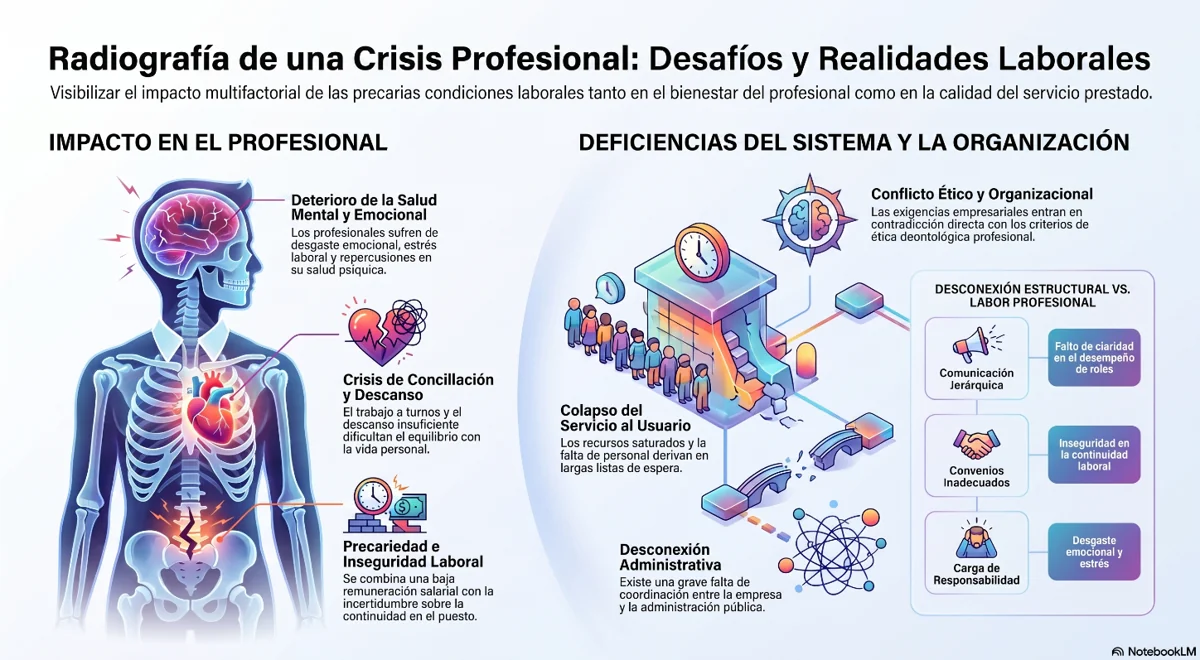
Despite the complaints of the professionals, working conditions in the RCM have not been improved. They state that they are ignored by companies and the administration, despite the paradox of working in equal resources, which leads them to consider changing jobs.
To conclude, it should be noted that we start from the certainty that caring for women victims of gender violence must start by taking care of the professionals and therefore this institutional violence exercised against the professionals who attend to gender violence must be made clear. A violence that feeds and reproduces the structural violence suffered by women as users of resources and also as professionals of these.
Social Work in the field of gender violence requires high specialization, is strongly feminized and with conditions that imply a violation of workers' labor rights and a serious setback in equality policies. All this affects the quality of the Social Work we carry out, leading professionals to a situation of learned helplessness, chronic lack of protection, institutional violence and consequently a decrease in the quality of care for women, follow-ups and the entire protection system.
The results of the research reinforce the need to review and correct the existing shortcomings at the labor level in the sector of intervention in gender violence by the public administration, which is the owner of the resources.
Bibliographic references:
Canet, E. y García, E. (2006). El síndrome de burnout en profesionales que trabajan en violencia de género. Servicios Sociales y Política Social nº 75, 89-101. Consejo General de Trabajo Social.
Cuartero, ME (2018). Desgaste por empatía: cómo ser una profesional del Trabajo social y no desfallecer en el intento. Cuaderno de Trabajo Social, vol 11, nº 1, 9-31
Gobierno de España (2025). Medidas del Pacto de Estado contra la violencia de género 2025.
https://www.igualdad.gob.es/wp-content/uploads/Medidas-Renovacion-Pacto-de-Estado-VG.pdf
INSST Riesgos psicosociales en el Trabajo. Recuperado el 4 abril de 2025
https://www.insst.es/materias/riesgos/riesgos-psicosociales
Linares, JL (2002). Del abuso y otros desmanes. Paidós